How to pronounce Llanfairpwllgwyngyllgogerychwyrndrobwllllantysiliogogogoch. Llanfairpwllgwyngyllgogerychwyrndrobwllllantysiliogogogoch is a Welsh place-name noun, famously long and used to denote a specific village in Anglesey. It is pronounced as a single, continuous word and is often cited as one of the longest place names in the world. The form encodes a host of Welsh phonemes and morphemes, reflecting a compound meaning roughly describing a church in the hollow of the white hazel-stalk by the fierce whirlpool near St. Tysilio’s Church.
nounLlanfairpwllgwyngyllgogerychwyrndrobwllllantysiliogogogoch is a Welsh place-name noun, famously long and used to denote a specific village in Anglesey. It is pronounced as a single, continuous word and is often cited as one of the longest place names in the world. The form encodes a host of Welsh phonemes and morphemes, reflecting a compound meaning roughly describing a church in the hollow of the white hazel-stalk by the fierce whirlpool near St. Tysilio’s Church.
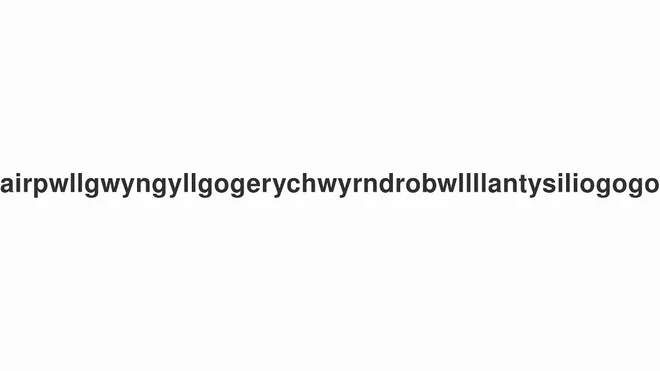
How to Pronounce Llanfairpwllgwyngyllgogerychwyrndrobwllllantysiliogogogoch
"We flew to Anglesey and visited Llanfairpwllgwyngyllgogerychwyrndrobwllllantysiliogogogoch, best known for its famously long name."
"A Welsh guide explained the etymology of Llanfairpwllgwyngyllgogerychwyrndrobwllllantysiliogogogoch and its components."
"Locals sometimes shorten the village name in casual speech, but signage still reads Llanfairpwllgwyngyllgogerychwyrndrobwllllantysiliogogogoch."
Pronounce as a continuous Welsh word: /ɬanˈvairpwɬɡwɪŋˈɡɪlɡɔˈɡoɡoɡɔx/ (approx). Key stresses fall on the penultimate and antepenultimate-syllables in the overall sequence due to Welsh stress rules: primary stress near the middle of long words. Start with Llan-, the 'll' is a voiceless lateral fricative, produced with the tongue blade raised to the alveolar ridge and the sides of the tongue allowing air to escape. Then 'fair' roughly as 'vair' in Welsh, with a short i sound, and continue through the sequence with careful attention to the 'pwll' cluster (p + w + ll). The entire word is pronounced in one breath, with moderate tempo and smooth transitions between consonant clusters. For accuracy, listen to native Welsh pronunciations and copies from authoritative dictionaries.
Common errors include treating 'll' as a simple 'l' sound, misplacing stress on the wrong syllable, and breaking the word into smaller, English-like chunks. Correct by producing the initial voiceless lateral fricative /ɬ/ for 'll', ensuring the 'pwll' sequence includes a /p/ followed by /w/ before the /ɬ/. Accurately rolling or approximating the Welsh rhotics can matter, as well as maintaining the continuous flow across the lengthy sequence without strong pauses. Practice with slow, segmented reading at first, then gradually blend the segments while preserving each phoneme’s place of articulation.
In US, UK, and AU, you’ll notice differences in rhotics, vowel quality, and finale consonants. Welsh pronunciation uses a voiceless lateral fricative /ɬ/ at 'll', which is generally absent or approximated in English accents. Vowel vowels like 'a', 'i', and 'o' shift toward more English diphthongal realizations in US and AU speech, while UK listeners may preserve shorter, crisper vowels similar to British Welsh. The 'ch' end of 'och' is avelar fricative /x/ or /ɣ/ for Welsh; in many English variants it's simplified to /x/ or /k/ depending on the speaker. Finally, the 'r' is tapped or rolled in Welsh-influenced speech, whereas in most English varieties it is a simple 'r' or approximant. Aim for a faithful Welsh base in all three regions, but expect softer rhotics and vowel shifts in non-Welsh speakers.
It’s the conglomeration of multiple native Welsh phonemes and long consonant clusters, including /ɬ/ (ll), /rw/ sequences, and /ɡɔɡoɡɔx/ endings with /x/. The continuous length and minimal segmentation increase cognitive load; you must map each morpheme into a single flow. The string includes several similar syllables with subtle vowel changes that require precise tongue positioning and breath control. The primary challenges are the initial 'll', the 'pwll', the 'wyrn' clusters, and the 'gogogoch' ending where the 'ch' requires an aspirated velar fricative. Developing muscle memory through shadowing and segmentation helps mitigate these difficulties.
A unique feature is the initial 'll' /ɬ/, a rare Welsh voiceless lateral fricative. It is produced with the tongue blade raised to the alveolar ridge and the air escaping along the sides of the tongue, with no vocal cord vibration for this sound. Additionally, the sequence includes long, dense clusters like 'pwll' and 'drobwll', requiring careful timing to avoid inserting syllable breaks. Mastery comes from practicing the 'll' cluster in isolation, then combining it with adjacent consonants, maintaining continuous airflow across the entire word.
🗣️ Voice search tip: These questions are optimized for voice search. Try asking your voice assistant any of these questions about "Llanfairpwllgwyngyllgogerychwyrndrobwllllantysiliogogogoch"!
Llanfairpwllgwyngyllgogerychwyrndrobwllllantysiliogogogoch is a Welsh toponym formed as a multi-part compound. The first element, Llanfair, combines Llan (church) with fair (Mary), referencing Saint Mary’s church. Pwll (pool/billabong) wyngyll (white hazel) suggests a pool near the white hazel trees. Goger(y) (to near) y chwyrn (whirlpool) drobwll (bog-well) llan (church/landing) tysiliogogogoch links to Saint Tysilio’s church near a red cave/lachrymal valley and the cave-mouth region. The entire name depicts a geographical route: “St. Mary’s church in the hollow of the white hazel near the fierce whirlpool by St. Tysilio’s church and the red cave.” First attested modern usage dates from the 19th century revival of Welsh toponymy and the construction of the Alnwick-like signage; it was popularized in the late 19th and early 20th centuries as a tourist gimmick, with its length becoming a symbol of Welsh linguistic heritage. The name is an assemblage of semantic morphemes, each element preserving Welsh phonotactics and phonology, and it embodies a traditional practice of stacking descriptive placenames to convey landscape features. Modern usage is largely ceremonial and touristic, though the name remains a living linguistic monument in Welsh culture and education. The precise first known written instance is difficult to pin down, but it appears in 1860s-1880s Welsh-language literature and railway signage, later cemented by travel writers and the popular press as an emblem of Welsh identity and linguistic resilience.
💡 Etymology tip: Understanding word origins can help you remember pronunciation patterns and recognize related words in the same language family.
Help others use "Llanfairpwllgwyngyllgogerychwyrndrobwllllantysiliogogogoch" correctly by contributing grammar tips, common mistakes, and context guidance.
💡 These words have similar meanings to "Llanfairpwllgwyngyllgogerychwyrndrobwllllantysiliogogogoch" and can often be used interchangeably.
🔄 These words have opposite meanings to "Llanfairpwllgwyngyllgogerychwyrndrobwllllantysiliogogogoch" and show contrast in usage.
📚 Vocabulary tip: Learning synonyms and antonyms helps you understand nuanced differences in meaning and improves your word choice in speaking and writing.
Words that rhyme with "Llanfairpwllgwyngyllgogerychwyrndrobwllllantysiliogogogoch"
-alk sounds
Practice with these rhyming pairs to improve your pronunciation consistency:
🎵 Rhyme tip: Practicing with rhyming words helps you master similar sound patterns and improves your overall pronunciation accuracy.
