Beyond Basic Pronunciation
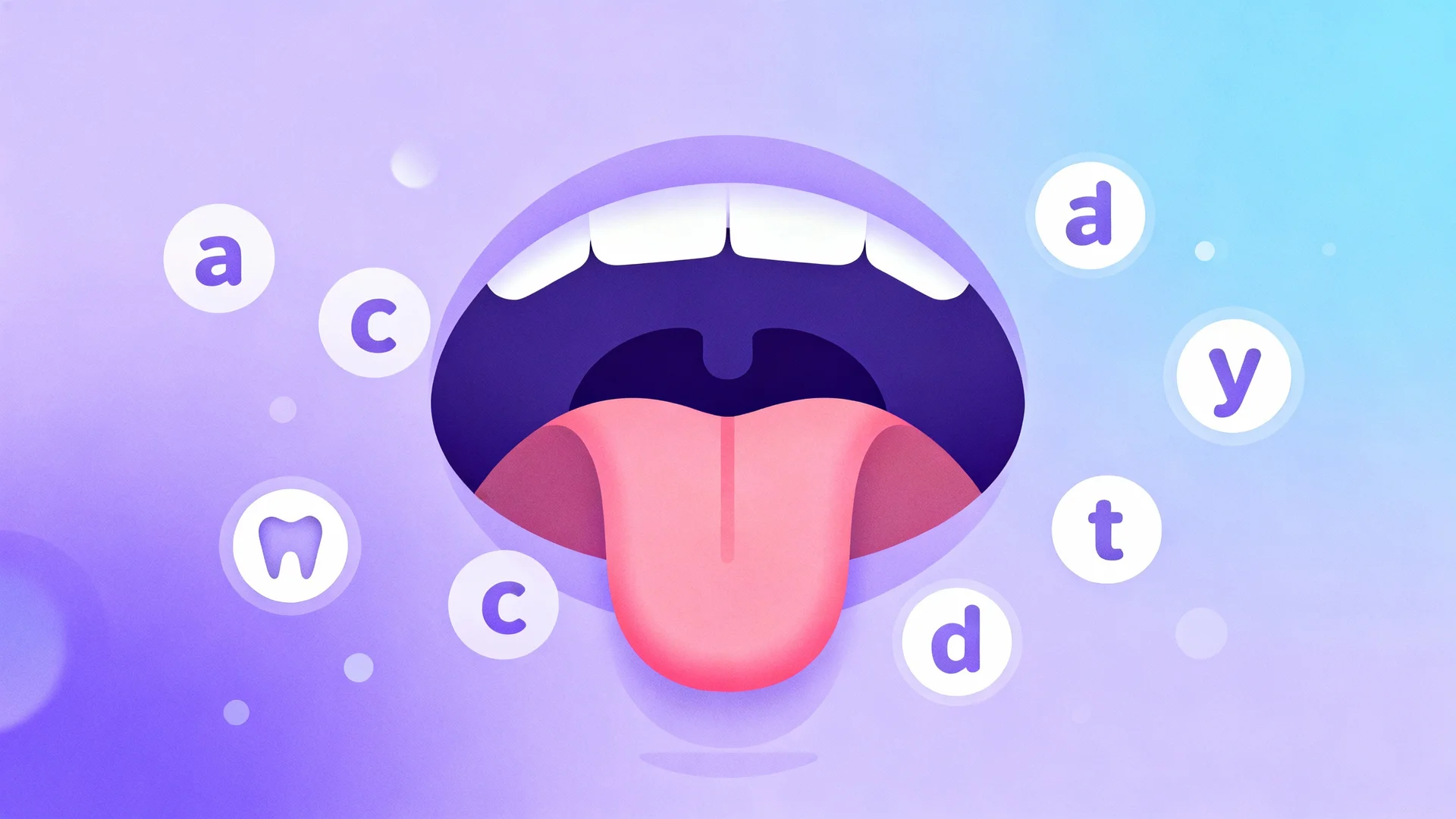
Once you've learned individual sounds, the next level is mastering precise articulation—the exact positioning and movement of your articulators (tongue, lips, jaw, soft palate) to produce clear, effortless speech.
Understanding Your Articulators
The Tongue
Your most flexible and important articulator:
- Tip: Touches teeth ridge for /t/, /d/, /n/, /l/
- Blade: Creates /s/, /z/, /ʃ/, /ʒ/
- Back: Rises for /k/, /g/, /ŋ/
- Root: Advances or retracts for different vowels
The Lips
Create different sound qualities:
- Rounded: /uː/, /ʊ/, /oʊ/, /w/
- Spread: /iː/, /ɪ/, /eɪ/
- Relaxed: /ə/, /ʌ/
- Together: /p/, /b/, /m/
The Jaw
Controls mouth opening:
- Wide open: /ɑː/, /æ/
- Mid open: /ɛ/, /ʌ/
- Nearly closed: /iː/, /uː/
The Soft Palate (Velum)
Controls nasal airflow:
- Lowered: /m/, /n/, /ŋ/ (nasal sounds)
- Raised: All other sounds (oral sounds)
Advanced Techniques for Common Sounds
Perfect /r/ Articulation
American /r/:
- Curl tongue tip slightly back (don't touch roof of mouth)
- Tense tongue sides against back molars
- Round lips slightly
- Voice the sound
British /r/:
- Tap tongue tip briefly against alveolar ridge
- Less lip rounding than American
- Often only before vowels
Crisp /l/ vs. Dark /l/
Clear /l/ (before vowels):
- Tongue tip touches alveolar ridge
- Front of tongue stays low
- Example: "light" /laɪt/
Dark /l/ (after vowels, end of words):
- Tongue tip touches alveolar ridge
- Back of tongue raises toward velum
- Example: "feel" /fiːɫ/
Precise Sibilants (/s/, /z/, /ʃ/, /ʒ/)
For /s/ and /z/:
- Tongue tip near (not touching) alveolar ridge
- Create narrow channel for air
- Teeth nearly together
- /z/ adds voicing
For /ʃ/ and /ʒ/:
- Tongue tip slightly back from /s/ position
- Lips slightly rounded/protruded
- Wider air channel than /s/
- /ʒ/ adds voicing
Jaw Control Exercises
Exercise 1: Jaw Relaxation
- Massage jaw joints (in front of ears)
- Open mouth wide, then relax (10 times)
- Move jaw side to side slowly
- Make small circles with jaw
Exercise 2: Controlled Jaw Opening
Practice these vowels with increasing jaw opening:
- /iː/ ("see") - minimal opening
- /ɪ/ ("sit") - slightly more
- /ɛ/ ("set") - mid opening
- /æ/ ("sat") - large opening
- /ɑː/ ("father") - maximum opening
Tongue Positioning Exercises
Exercise 1: Tongue Awareness
- Touch tongue tip to alveolar ridge (behind upper teeth)
- Slide it back along roof of mouth
- Raise back of tongue while keeping tip down
- Practice switching between front and back tongue positions
Exercise 2: Tongue Flexibility
Alternate rapidly between:
- /kiː/ - /tiː/ (back tongue vs. front tongue)
- /liː/ - /riː/ (tip forward vs. tip back)
- /siː/ - /ʃiː/ (front vs. slightly back)
Lip Rounding and Spreading
Exercise 1: Lip Workout
- Wide smile (/iː/), hold 5 seconds
- Tight pucker (/uː/), hold 5 seconds
- Alternate 10 times
- Gradually increase speed
Exercise 2: Vowel Sequences
Practice smooth lip transitions:
- /iː/ → /uː/ → /iː/ (spread to round)
- /eɪ/ → /oʊ/ → /eɪ/ (slight round to full round)
- /æ/ → /ɑː/ → /æ/ (wide open with different tongue positions)
Coordinating Multiple Articulators
Complex Sounds Requiring Coordination
/tw/ cluster:
- Start with /t/: tongue tip at alveolar ridge
- While releasing /t/, round lips for /w/
- Requires simultaneous tongue and lip movement
/skr/ cluster:
- /s/: tongue tip near ridge, air channel
- /k/: back of tongue up, stop air
- /r/: curl tongue back while releasing /k/
- Three distinct tongue positions in rapid succession
Mirror Work for Precision
What to Observe
- Lip position: Are they rounded, spread, or neutral?
- Jaw opening: How wide is your mouth?
- Tongue visibility: Can you see your tongue for /θ/ and /ð/?
- Symmetry: Are both sides of your mouth working equally?
- Tension: Are you tensing unnecessary muscles?
Common Articulation Problems
Problem: Lazy Articulation
Symptoms: Mumbled speech, unclear consonants
Solution: Exaggerate articulation in practice, then moderate for natural speech
Problem: Excessive Tension
Symptoms: Fatigue, strained voice, unnatural sound
Solution: Practice relaxation exercises, find minimal effort for maximum clarity
Problem: Wrong Articulator for Sound
Symptoms: /θ/ sounding like /f/ (using lips instead of tongue)
Solution: Use mirror to verify correct articulator placement
Advanced Practice Routine
Daily Articulation Workout (15 minutes)
Warm-up (3 minutes):
- Jaw massage and mobilization
- Tongue stretches and movements
- Lip rounding and spreading
Precision Practice (7 minutes):
- Difficult sounds in isolation (2 min)
- Consonant clusters (2 min)
- Vowel transitions (2 min)
- Full words incorporating all above (1 min)
Integration (5 minutes):
- Read passage focusing on articulation
- Record and analyze
- Note improvements and remaining challenges
Measuring Progress
Track these indicators:
- Clarity: Do people ask you to repeat yourself less often?
- Effort: Does clear articulation require less conscious effort?
- Speed: Can you maintain clarity at natural speaking speed?
- Automaticity: Do correct positions happen without thinking?
- Feedback: What do native speakers notice about your pronunciation?
Conclusion
Advanced articulation is about developing precise, effortless control of your articulators. Through targeted exercises, mirror work, and consistent practice, you can achieve crystal-clear pronunciation that sounds natural and unforced. Focus on understanding exactly what your mouth does for each sound, practice with awareness, and gradually build the muscle memory that makes excellent articulation automatic.